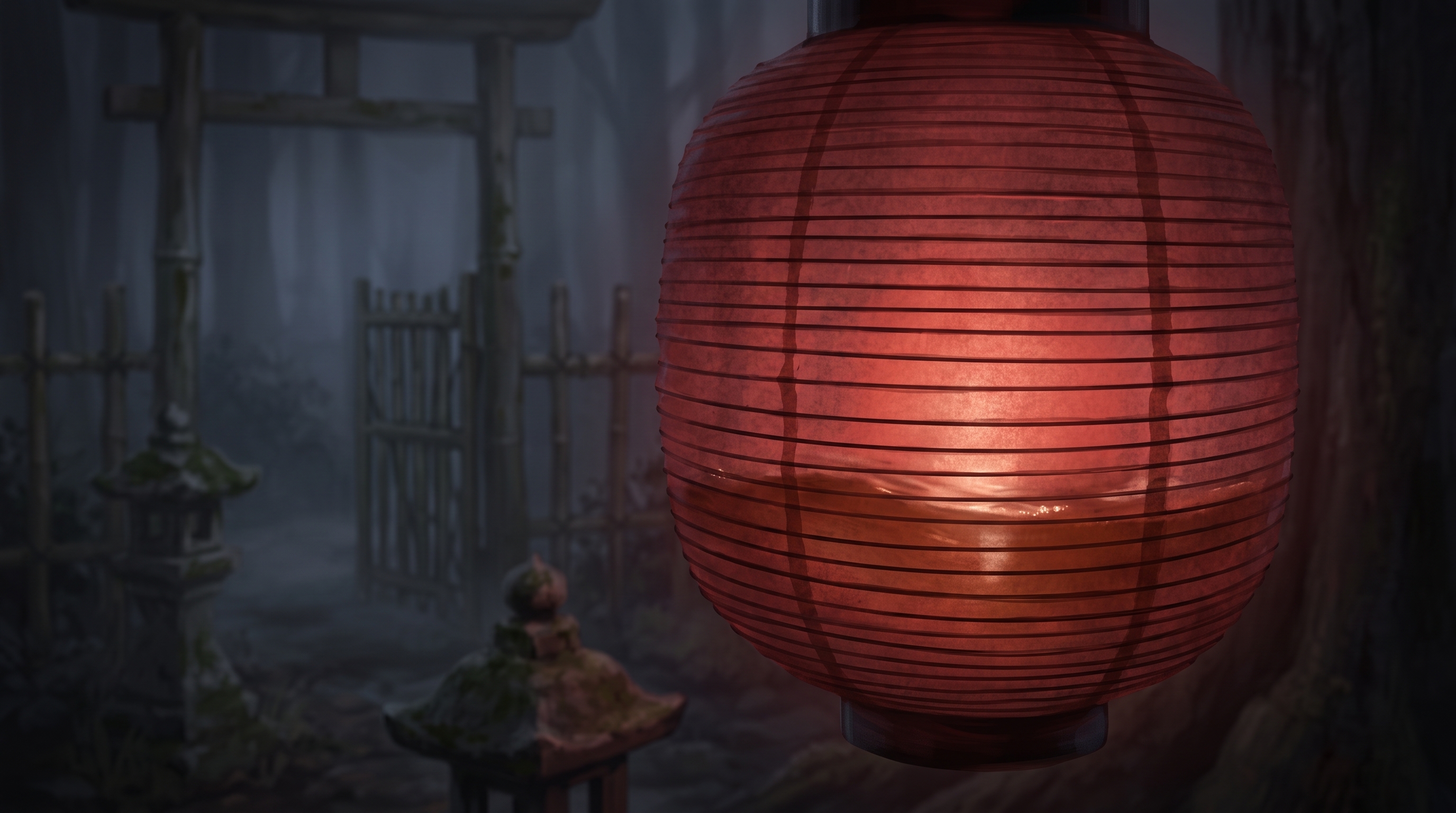

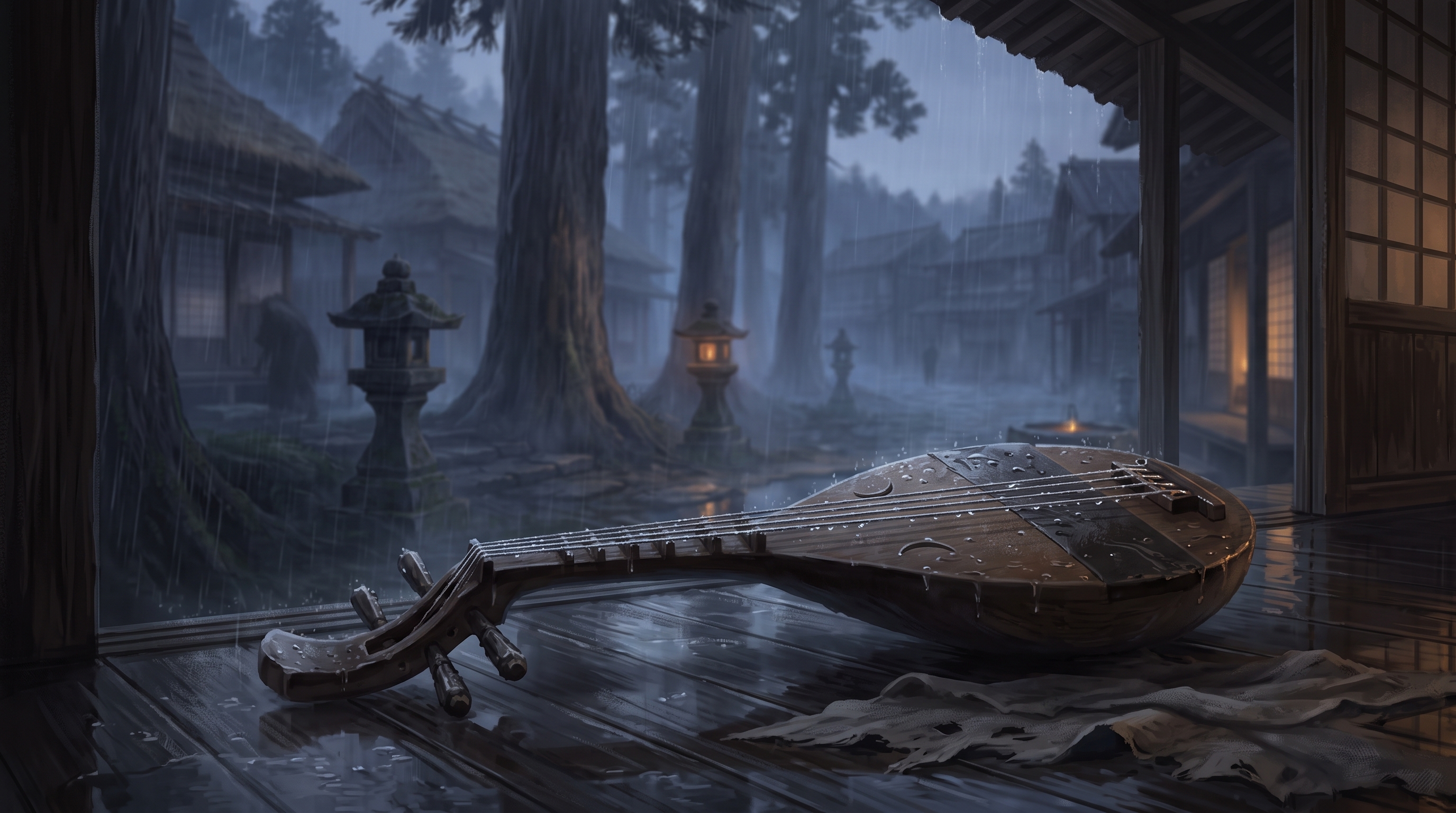
The strings of a biwa do not sound like other instruments when struck in anger. They crack rather than ring, and on the night in question, beneath the sound of rain on temple stone, a blind man’s voice was chanting the death of an empire to no audience that the living could see.
What the temple servants found among the gravestones that night — a man soaked through, his sightless eyes fixed on a child-emperor’s memorial seven centuries dead — has survived as one of the most enduring ghost stories to come out of Japan.
This is the historical and literary record behind Hoichi the Earless, the Blind Biwa Priest of Akamagaseki, a kaidan rooted in real war, real grief, and a temple built specifically to contain the dead.
The Strait Where an Empire Drowned
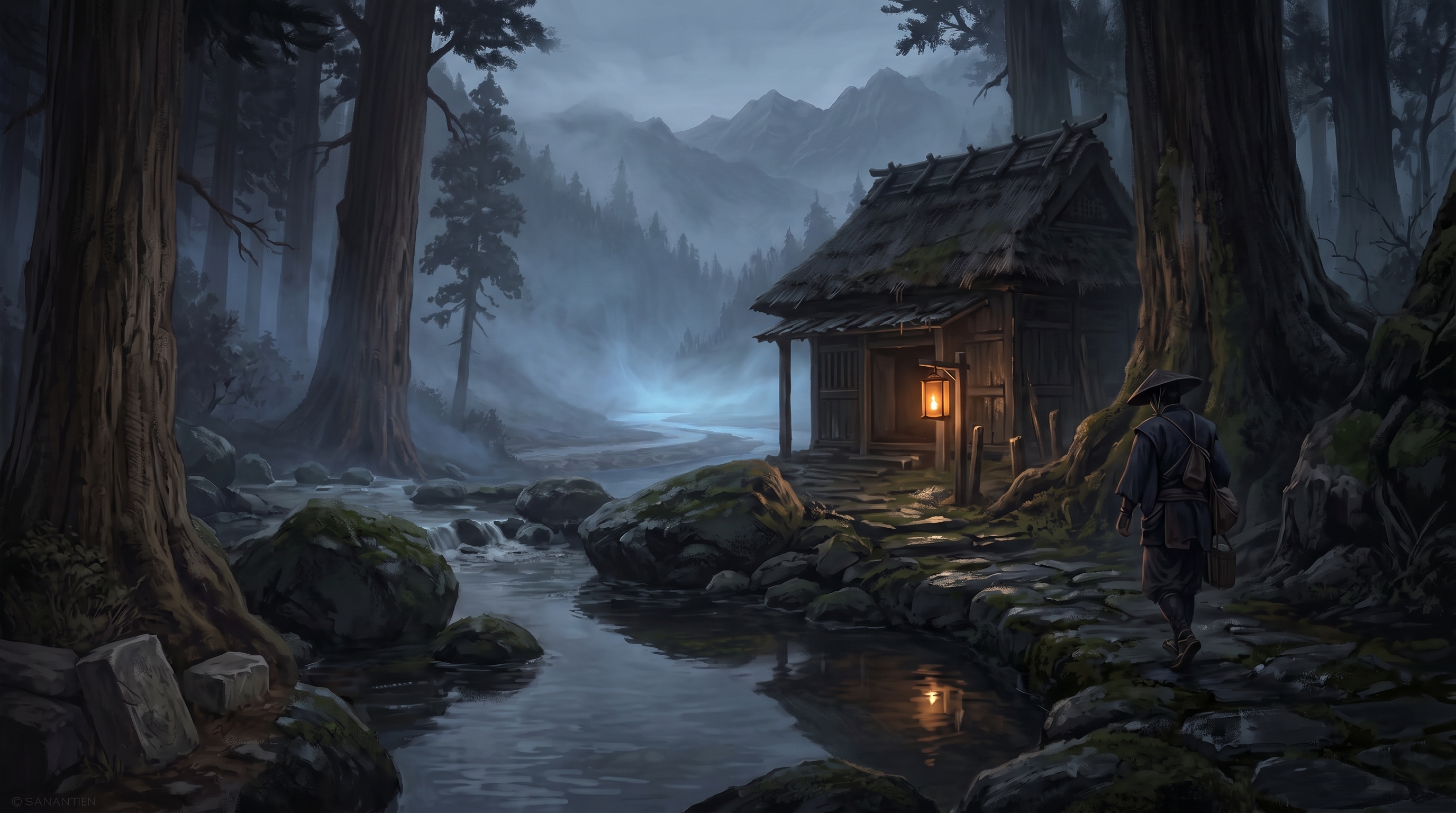
 Amida-ji Temple Grounds.
The haunting traces back to an actual catastrophe. In the fourth month of 1185, the naval battle of Dan-no-ura brought the Genpei War to its end in the narrow, current-choked waters of the Kanmon Strait, near what was then called Akamagaseki — the port now known as Shimonoseki, at the western tip of Honshu. The Taira clan, known in literary tradition as the Heike, were destroyed almost to the last person. Among the dead was the seven-year-old emperor Antoku, carried into the waves by his grandmother, Taira no Tokiko, rather than surrendered to the victorious Minamoto forces.
This was not a skirmish absorbed quietly into the historical record. The fall of the Heike became the subject of the Heike Monogatari, a sprawling war epic compiled from oral performance traditions over the following two centuries, most famously fixed into written form around 1371 in the version associated with the biwa performer Kakuichi. For generations before it was ever set down on paper, this story of drowned nobility was not read — it was chanted, by blind itinerant priests trained specifically to carry it from village to village on the strings of a biwa.
Amida-ji and the Unquiet Dead
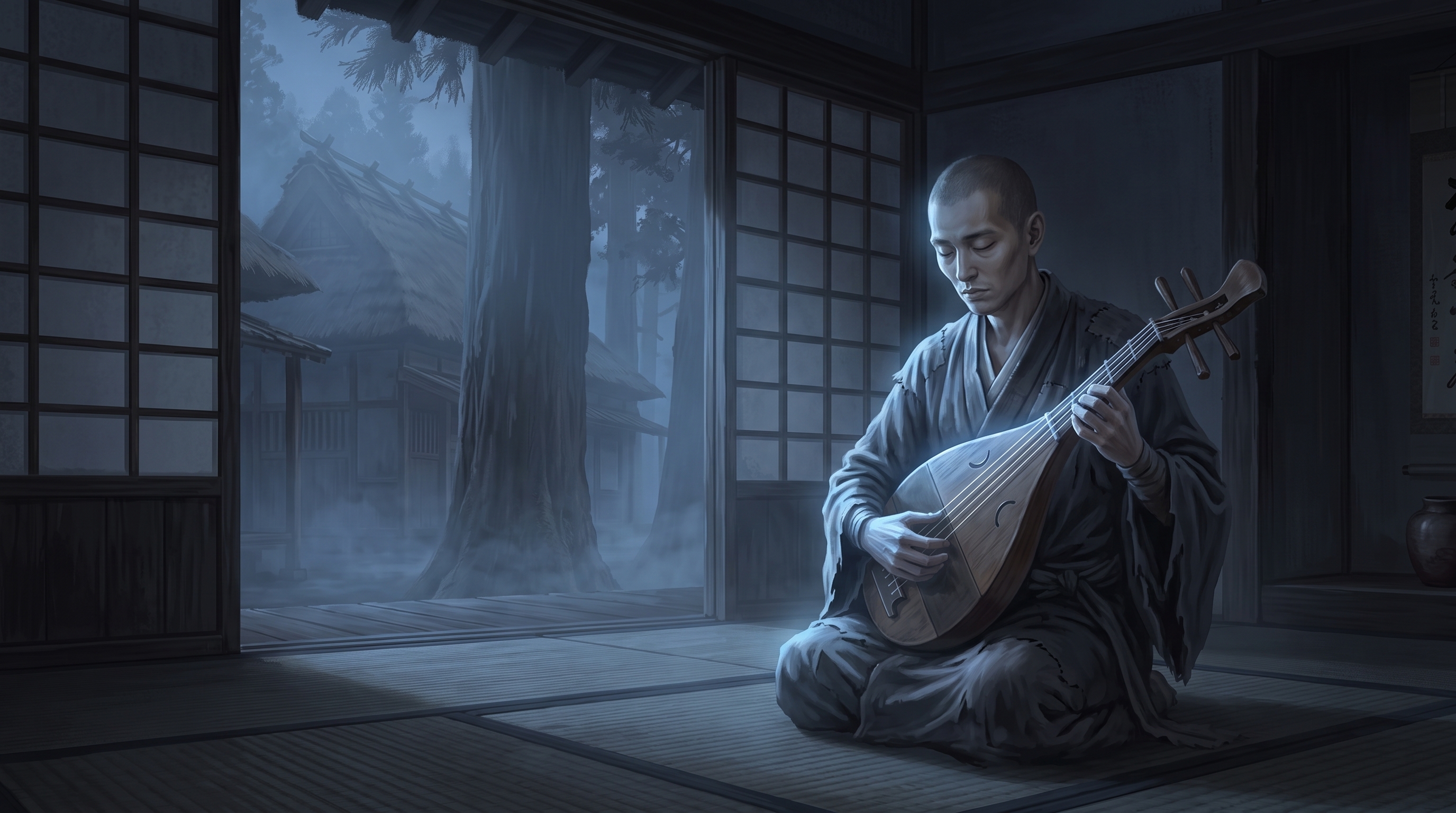 Departure in Twilight.
Hearn tells us that for seven hundred years, the shore at Akamagaseki was considered haunted, and the folklore attached to it is startlingly specific and still circulates today. Crabs pulled from the strait bear ridged markings on their shells resembling a contorted human face; they are called Heike crabs to this day, said to carry the fury of drowned samurai in their carapace. The creature is a real local species, and the folk explanation for its markings persists as a documented piece of regional belief rather than a literary invention.
On moonless nights, fishermen reported drifting corpse-fires along the waterline — what the coast called oni-bi, fires of the dead. A temple called Amida-ji was constructed on that shore specifically to pacify the drowned, its grounds raised with memorial stones bearing the names of Antoku and his retainers, and Buddhist rites performed there in their honor. The hauntings were said to soften under this ritual care. They did not, by any account, stop entirely.
The Blind Musician and the Nobleman’s House
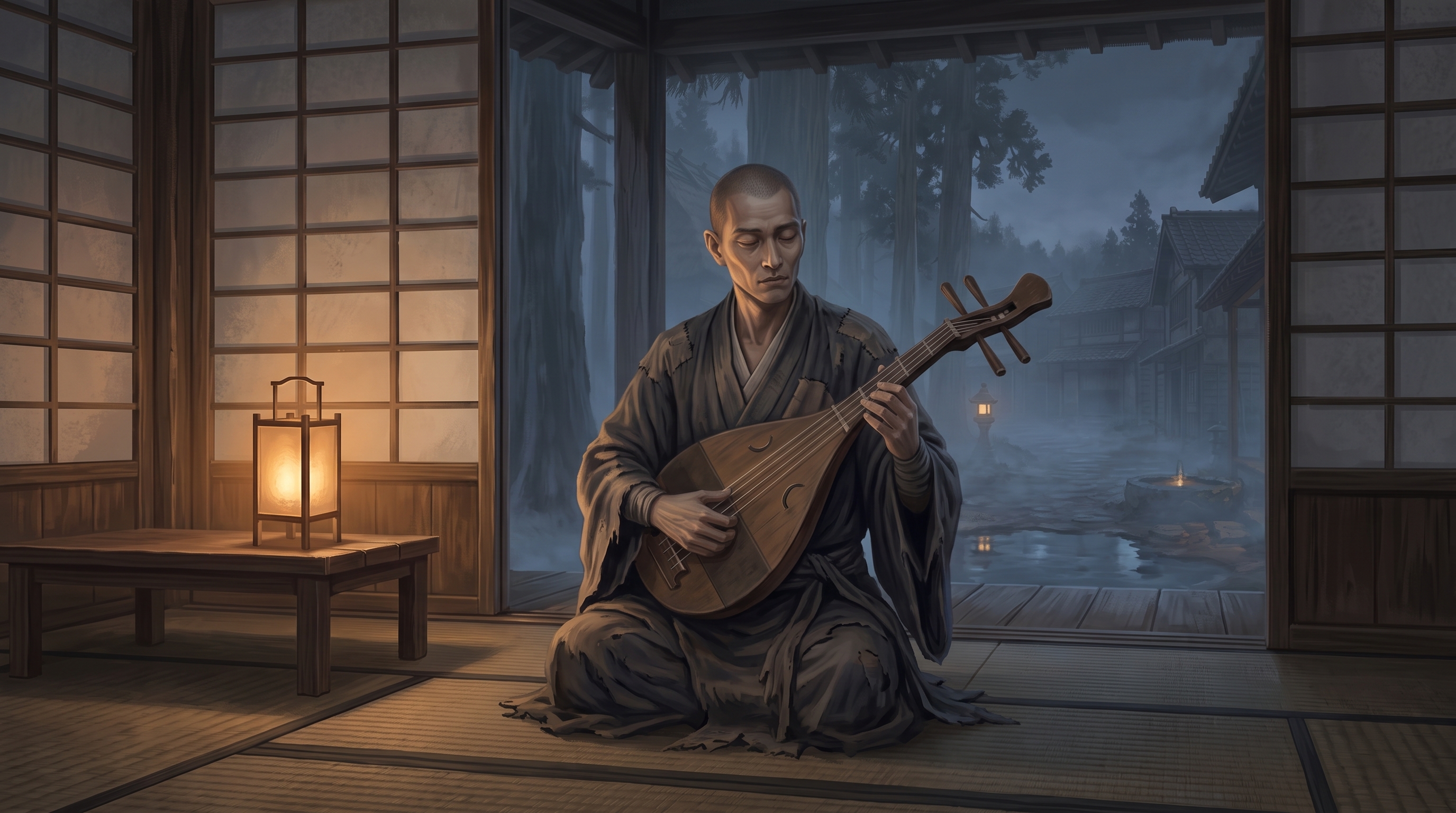
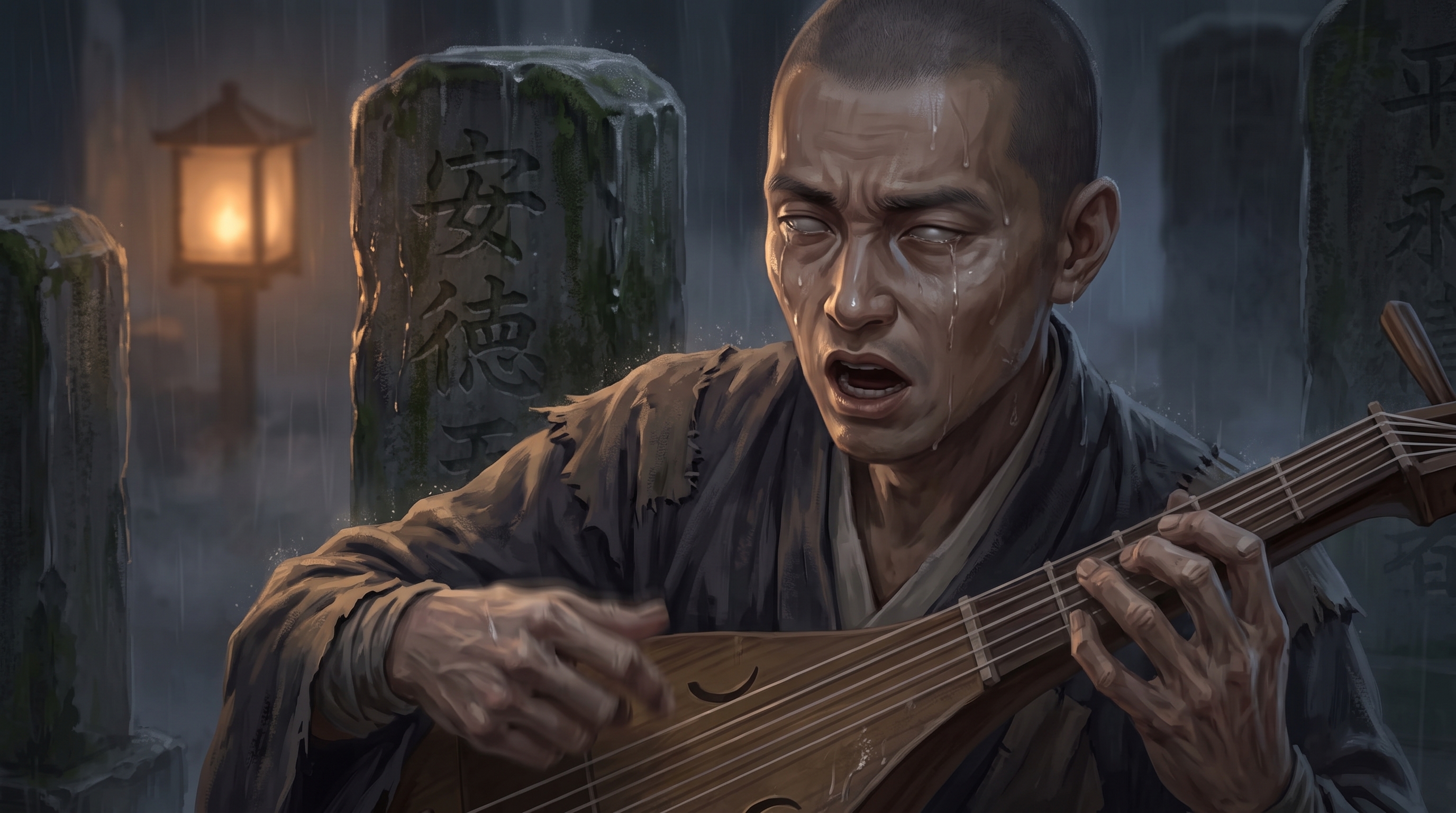 Tactile textures and subtle details of Hoichi sitting silently on the temple veranda in the early morning light, his.
Into this uneasy arrangement between temple and sea came Hōichi, a blind biwa performer taken in by Amida-ji’s priest, given lodging, and asked only to play on quiet evenings. He had trained since childhood and, by youth, had already surpassed his teachers — known above all for his rendition of the Heike’s fall, a performance so affecting that it was said even kijin, demons themselves, could not hold back tears hearing it.
One summer night, with the priest away performing a memorial rite, a visitor arrived at the temple gate claiming to serve a lord of very great rank who wished to hear the famous blind musician perform the tale of Dan-no-ura. Hōichi, bound by the social weight of a samurai’s command, followed without question — led by a hand “hard as iron,” through what he understood to be a grand residence filled with silk-clad listeners speaking in the formal cadence of the imperial court.
He played the fall of the Heike as he never had before, and the hall did not merely applaud — it wailed, a grief so total it frightened him without his understanding why. He was summoned six more nights, sworn to secrecy, and returned before dawn to the exact veranda where he had been found.
Only when temple servants secretly followed him through the rain did the truth surface: no mansion existed. Hōichi had been playing, night after night, seated before Antoku’s memorial stone in a graveyard suddenly crowded with corpse-fire, to an audience of the Heike dead themselves.
The Sutra Left Unfinished
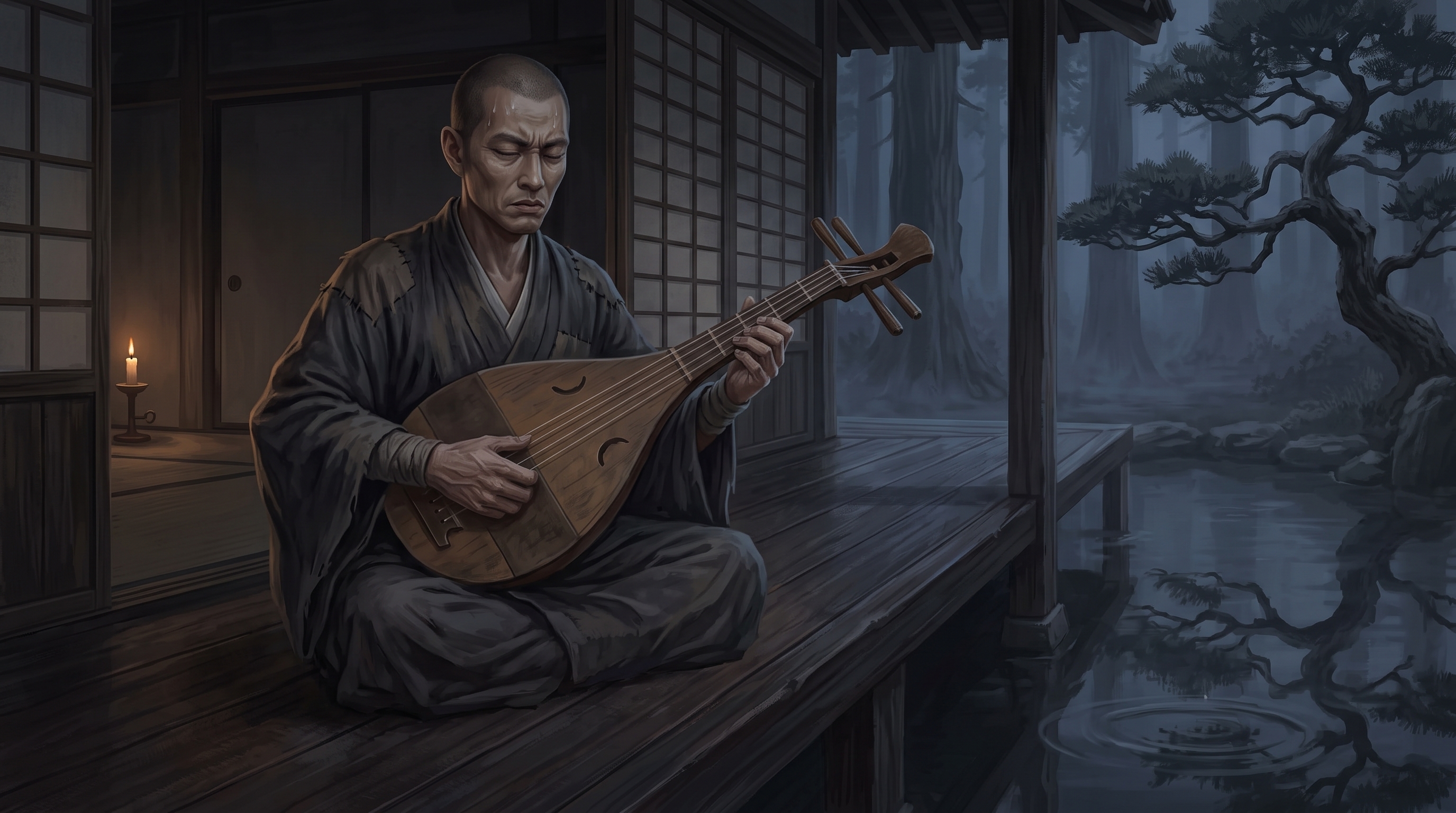 Priest’s Ash-Colored Face.
The priest’s response reflects genuine Buddhist ritual practice of the period rather than narrative invention. Protective sutra inscription onto the body — using ink and brush to cover the skin in sacred text as a barrier against spiritual intrusion — appears across historical Japanese exorcism and protective ritual.
The Heart Sutra (Hannya Shingyō) specifically was, and remains, one of the most commonly chanted texts in Japanese Buddhist practice for the dead. The priest and his acolyte inscribed Hōichi’s entire body, instructing him to sit motionless and silent through the night no matter what called to him, on the understanding that an unanswered, unseen presence cannot be seized.
The spirit came, called his name three times, found no response, and declared there was “nothing here but two ears.” In the single oversight of the night — the acolyte had failed to inscribe the ears themselves — the dead found their one point of purchase. Hōichi endured the mutilation without a sound, exactly as instructed, and by that discipline preserved the rest of himself. He lived on, celebrated as a performer, forever after known only as Mimi-nashi Hōichi — Hōichi the Earless.
Archival Roots: From Oral Kaidan to Hearn’s Kwaidan
The written record modern readers encounter comes from Lafcadio Hearn, the Greek-Irish writer and naturalized Japanese citizen who collected the story into his 1904 volume Kwaidan: Stories and Studies of Strange Things. Hearn was explicit that he did not invent these tales; he gathered and translated them from older Japanese oral and literary tradition, already circulating as regional legend by the time he set them down at the close of the nineteenth century.
The story’s deep structural link to the historical biwa hōshi — blind monks who made their living reciting the Heike Monogatari from memory — situates it firmly within a genuine Edo-period and earlier performance culture, not a purely literary fabrication.
It is worth noting, as historical interpretation rather than settled fact, that the tale’s power rests partly on this double identity of the blind reciter: a living man practicing the same sacred profession once held by the very warriors he sang about, performing in the shadow of their actual grave markers. Whether any single historical Hōichi existed as Hearn describes cannot be verified through independent record; what can be verified is the temple, the battle, the memorial stones, and the centuries of local belief that fed the story long before it reached print.
Historical Legacy & Archival Footnotes
Amida-ji itself no longer stands under that name. Following the Meiji-era shinbutsu bunri policy separating Buddhist and Shinto institutions, the site was reorganized as Akama Jingū, a Shinto shrine that still maintains memorial markers to Emperor Antoku near the Shimonoseki waterfront. The Heike crab remains a recognized regional curiosity, still invoked in local tourism and folklore literature connecting the strait’s biology to its buried war dead. The Heart Sutra is reportedly still chanted at memorial services tied to the anniversary of Dan-no-ura, and reports of drifting lights along that stretch of water persist in regional kaidan collections into the modern era.
What endures in this story, beyond its historical furniture, is a meditation on obligation and silence. Hōichi’s peril comes not from disobedience but from obedience itself — he follows a command he has no power to refuse, exactly as the social order of his era required, and is nearly destroyed by it. His survival comes not from fighting the dead but from absolute stillness, a discipline the Edo-period reader would have recognized as its own form of spiritual courage. The tale asks what is owed to the dead, and what it costs the living to pay that debt in full, down to the last unprotected inch of skin.
Primary Texts & Scholarly References
- Lafcadio Hearn (1904), Kwaidan: Stories and Studies of Strange Things — the primary literary source for the modern telling of Hōichi’s tale.
- Kakuichi (compiler, c. 1371), Heike Monogatari — the war epic chronicling the Genpei War and the battle of Dan-no-ura, transmitted for centuries by biwa hōshi performers.
- Asai Ryōi (1666), Otogi Bōko — an earlier Edo-period kaidan collection illustrating the literary tradition from which ghost narratives like Hōichi’s draw their conventions.
- Ueda Akinari (1776), Ugetsu Monogatari — comparative reference for Edo-period tales of the dead returning to interact with the living.
- Regional folklore documentation on the Heike crab (Heikeopsis japonica) and its association with the drowned Taira clan, as recorded in Shimonoseki-area local histories.
- Historical records of Akama Jingū, Shimonoseki, documenting the site’s transition from the Buddhist temple Amida-ji under Meiji-era religious reorganization.
Soundtrack & Audio Credits
Music: ‘Bajuschki Baju’ by Kraosando (https://kraosando.bandcamp.com) — Licensed under CC BY 4.0