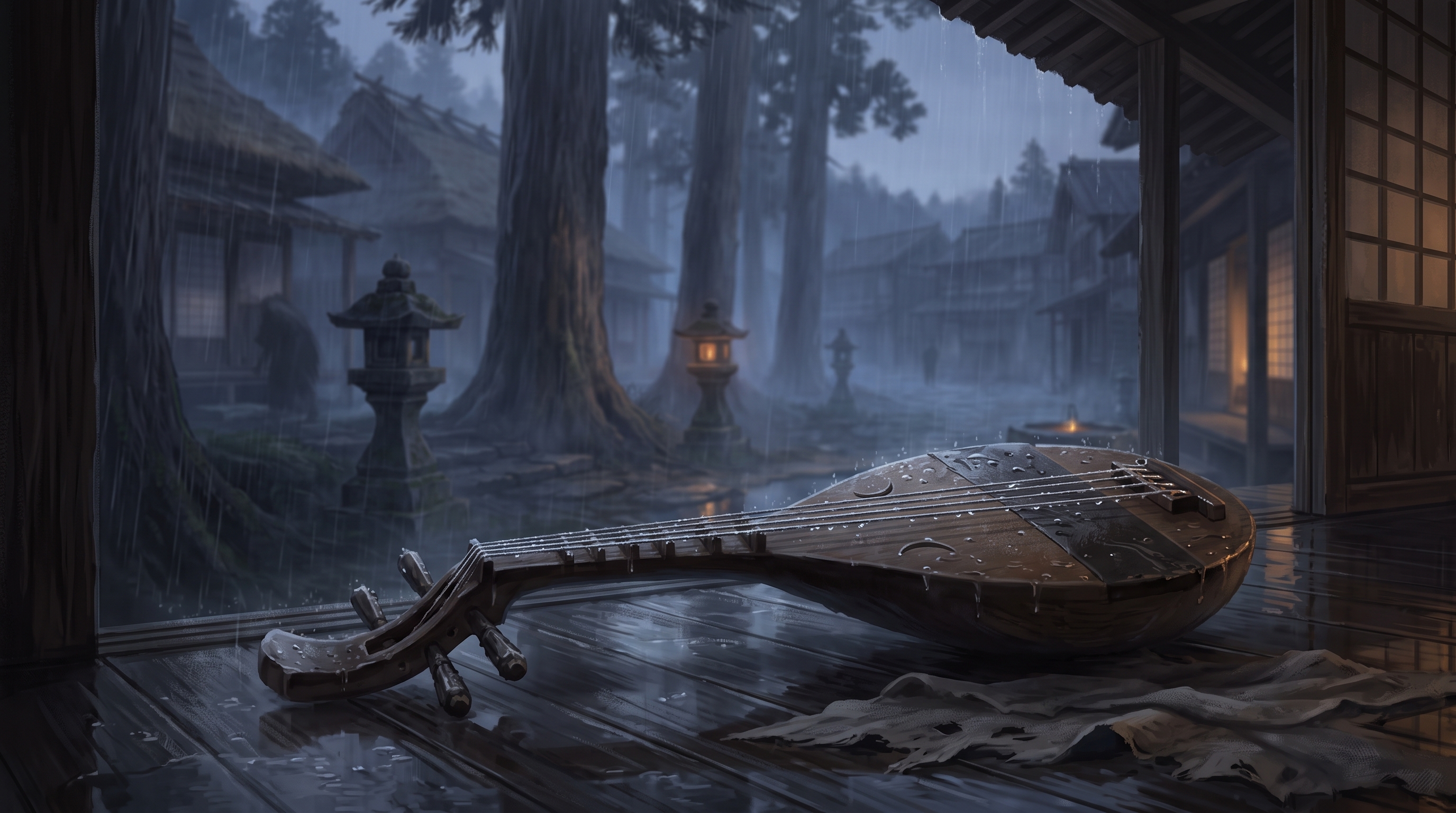

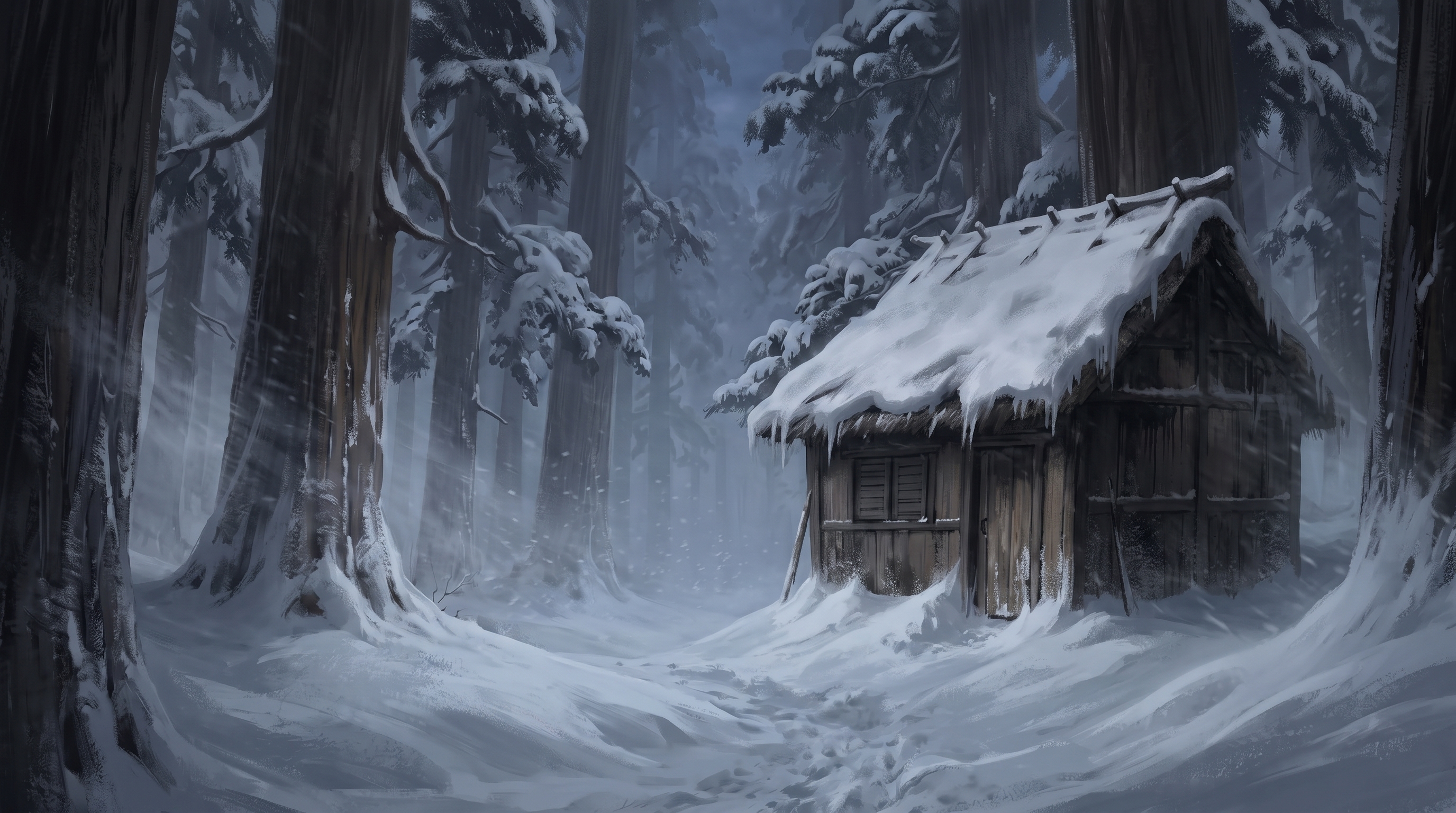
Two mats of floor, one door, no window — that is all the shelter that exists in the story, and it is almost enough to explain why the story has survived three centuries of retelling. A room that small leaves nothing to hide behind. When the door opens on its own in the middle of the night, there is no corner of the hut dark enough to pretend you did not see what came through it.
A Door That Opened Itself
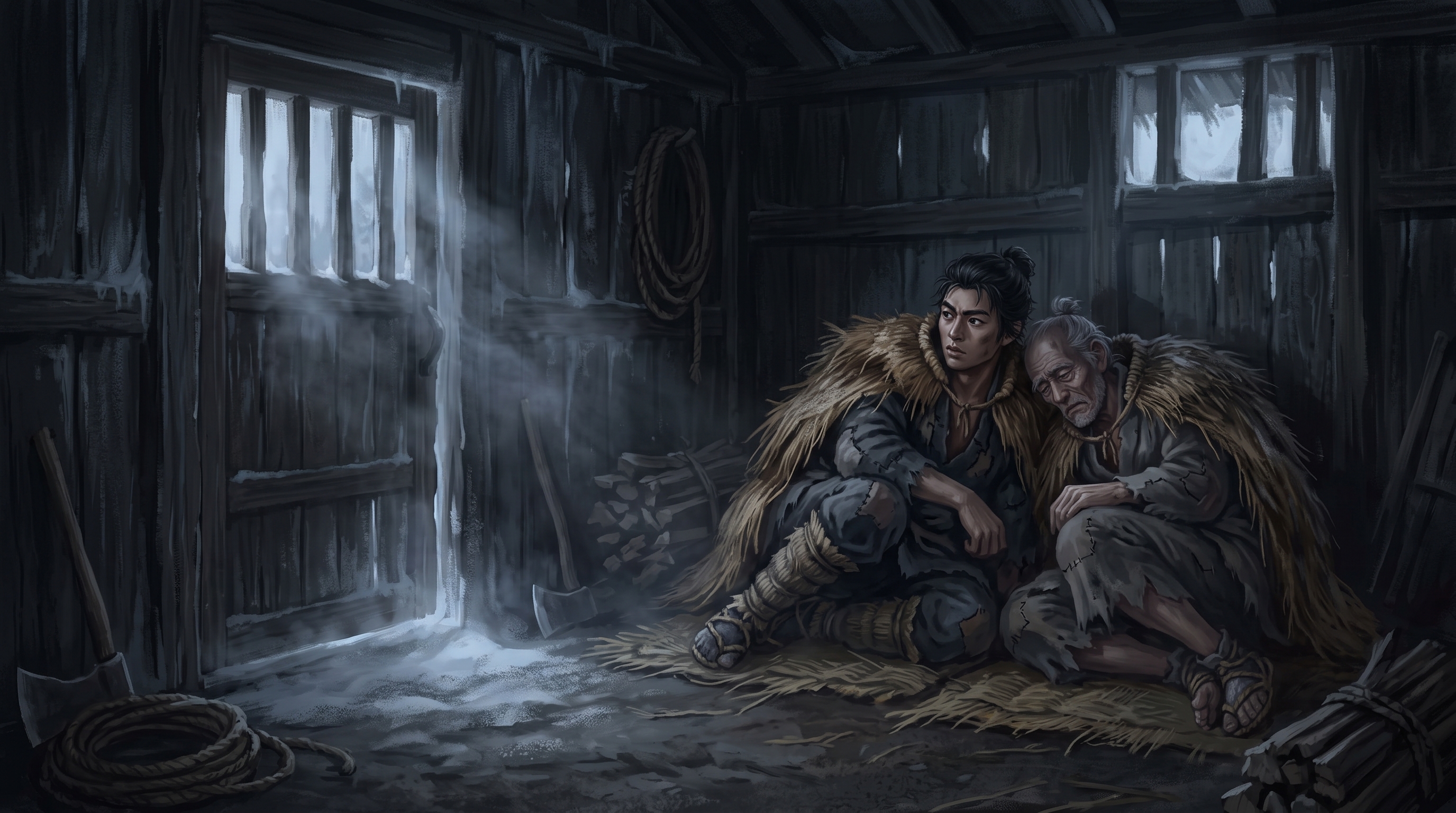 Huddled in the Dark Hut.
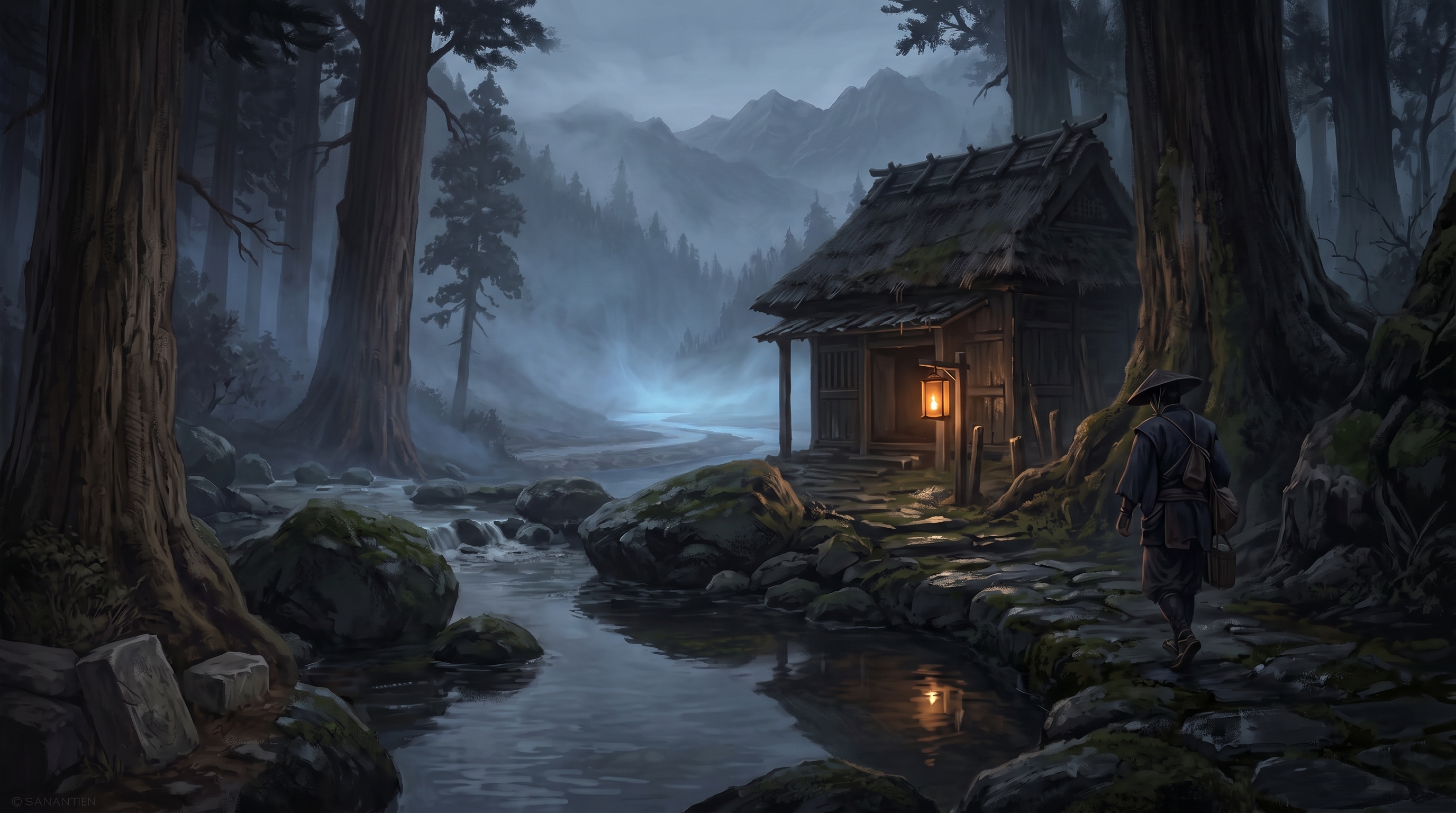
The woodcutters Mosaku and Minokichi were caught by weather, not by fate — at least at first. A ferry crossing on the far side of a flooded river, a shelter meant only for waiting out exactly this kind of storm, and two men too tired to do anything but lie down under straw raincoats and hope the night passed quickly. It did not. What entered the hut once the wind forced the door open was not wind at all, and the distinction between the two — between weather and something that merely resembles weather — sits at the cold center of this kaidan.
The woman in white knelt over the sleeping Mosaku and breathed onto his face until he froze without making a sound. She turned next to Minokichi, found him conscious, and chose — for reasons the story never explains and was perhaps never meant to — to let him live. She asked only one thing of him: silence. He kept it for a year, then broke it by accident, in front of his own wife, in his own home, by a paper lantern’s light. The woman listening to his confession, it turned out, already knew every word of it before he spoke.
Lafcadio Hearn and the Telling of Kwaidan
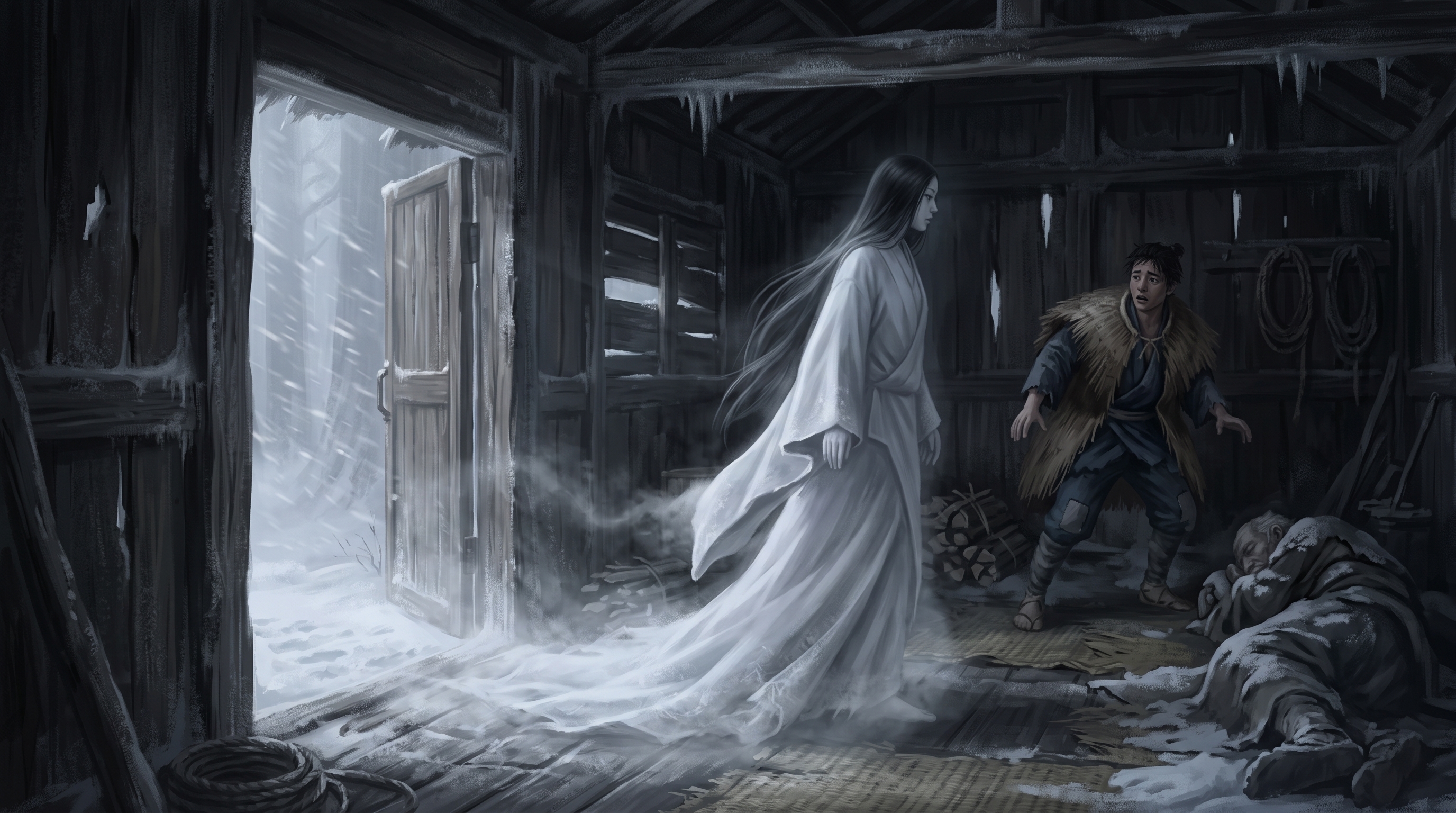 Woman Vanishing into Blizzard.
The written record of this encounter comes from Lafcadio Hearn, the Greek-Irish writer and naturalized Japanese citizen who, by 1904, had spent over a decade gathering ghost stories across the country under the Japanese name Koizumi Yakumo. His book Kwaidan: Stories and Studies of Strange Things collects seventeen tales, most drawn from stories told to him rather than from manuscripts he located himself. Hearn was explicit that he believed this particular account rooted in older oral tradition from Musashi Province, though he supplies no date, no village name, and no named informant for this specific telling.
That absence of documentation is not a flaw in Hearn’s method so much as a feature of the kaidan genre itself. Japanese ghost storytelling, as practiced across the Edo period, rarely demanded verification — a tale’s authority came from its telling, from the hyakumonogatari kaidankai parlor-game tradition of a hundred candle-lit ghost stories told in sequence, not from documentary proof. Hearn, arriving at the tail end of that tradition as a foreign folklorist with a trained eye, functioned less as an investigator than as a very careful transcriber of something already old when he found it.
Musashi Province itself gives the tale geographic weight even without a named village. The plain now holding Tokyo in its palm was, through most of the Edo period, farmland and forest dotted with exactly the kind of isolated woodcutting settlements the story describes — a river too violent for a permanent bridge, a single ferryman servicing both banks, woodcutters crossing daily into forest that fed the capital’s demand for fuel and lumber. The setting is unremarkable by design. That ordinariness is what makes the intrusion of something inhuman into it land so hard.
The Breath of White Smoke: Anatomy of the Encounter
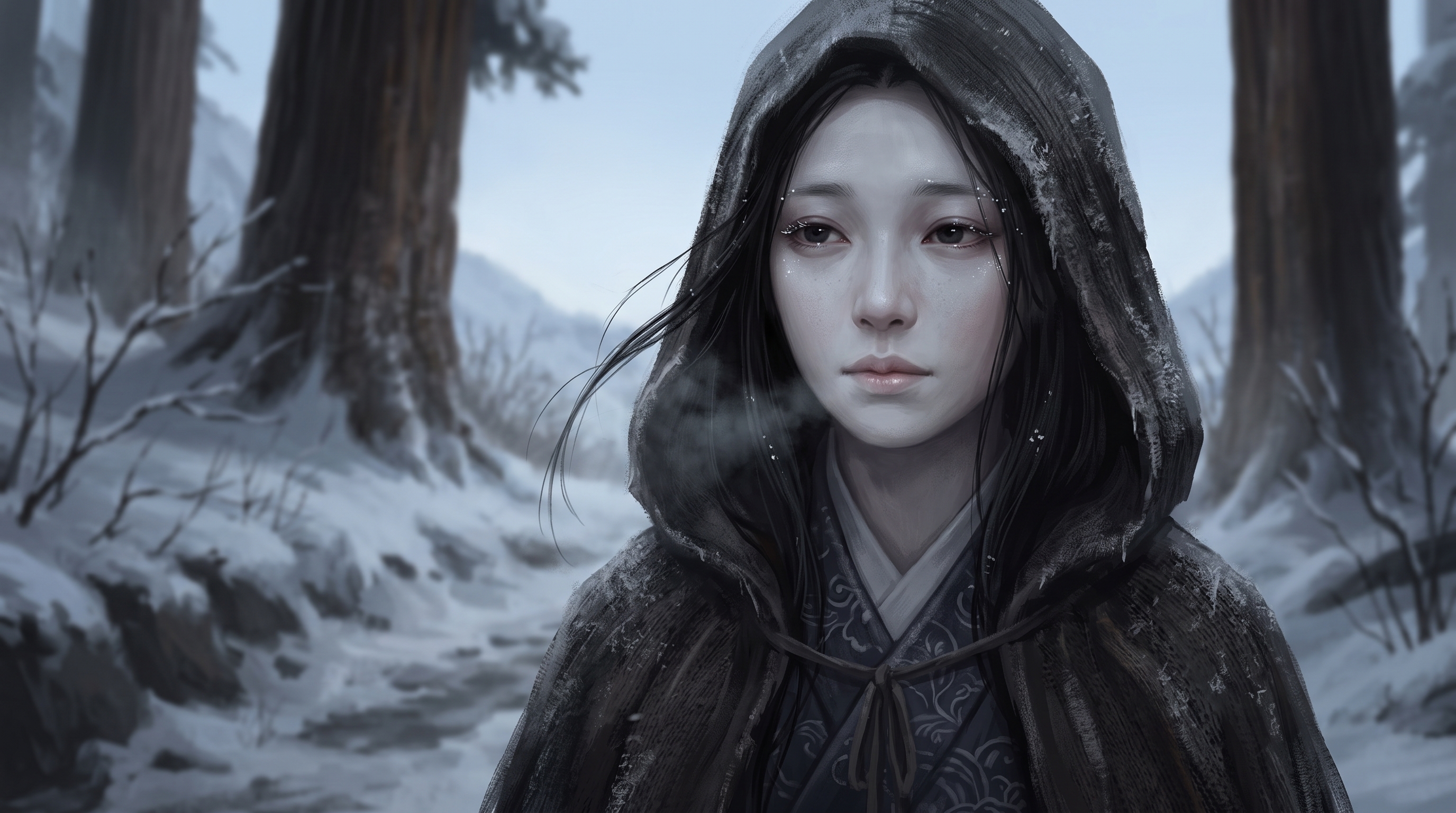 Warmth in Winter.
Hearn’s description of the moment itself is restrained almost to the point of austerity. The woman is dressed entirely in white. Her breath, bent over Mosaku’s sleeping face, is “like bright white smoke.” She is, even in Minokichi’s terror, unmistakably beautiful — and it is specifically her eyes, not her pallor or her stillness, that frighten him most. This detail recurs across yuki-onna folklore generally: the beauty is never in question, only what looks back at you from behind it.
Her warning to Minokichi is a contract, not a threat made in passing. “If you ever tell anyone — even your own mother — what you saw here tonight, I shall know it.” The phrasing matters: not merely that she would find out, but that she would simply know, the way one knows a fact about oneself. This is consistent with a broader pattern in Japanese folklore in which yōkai bind mortals through spoken vows rather than physical traps — the danger is never escape, but language.
Minokichi’s rationalizing afterward — telling himself the wind blew the door open, that he dreamed the face in the snowlight — is one of the story’s most human touches. Hearn gives him the exact reasoning a frightened person gives themselves at three in the morning, grasping for any explanation ordinary enough to let him go back to sleep. The story does not mock this impulse. It simply lets Mosaku’s frozen body answer it.
Oyuki: The Yōkai Who Stays
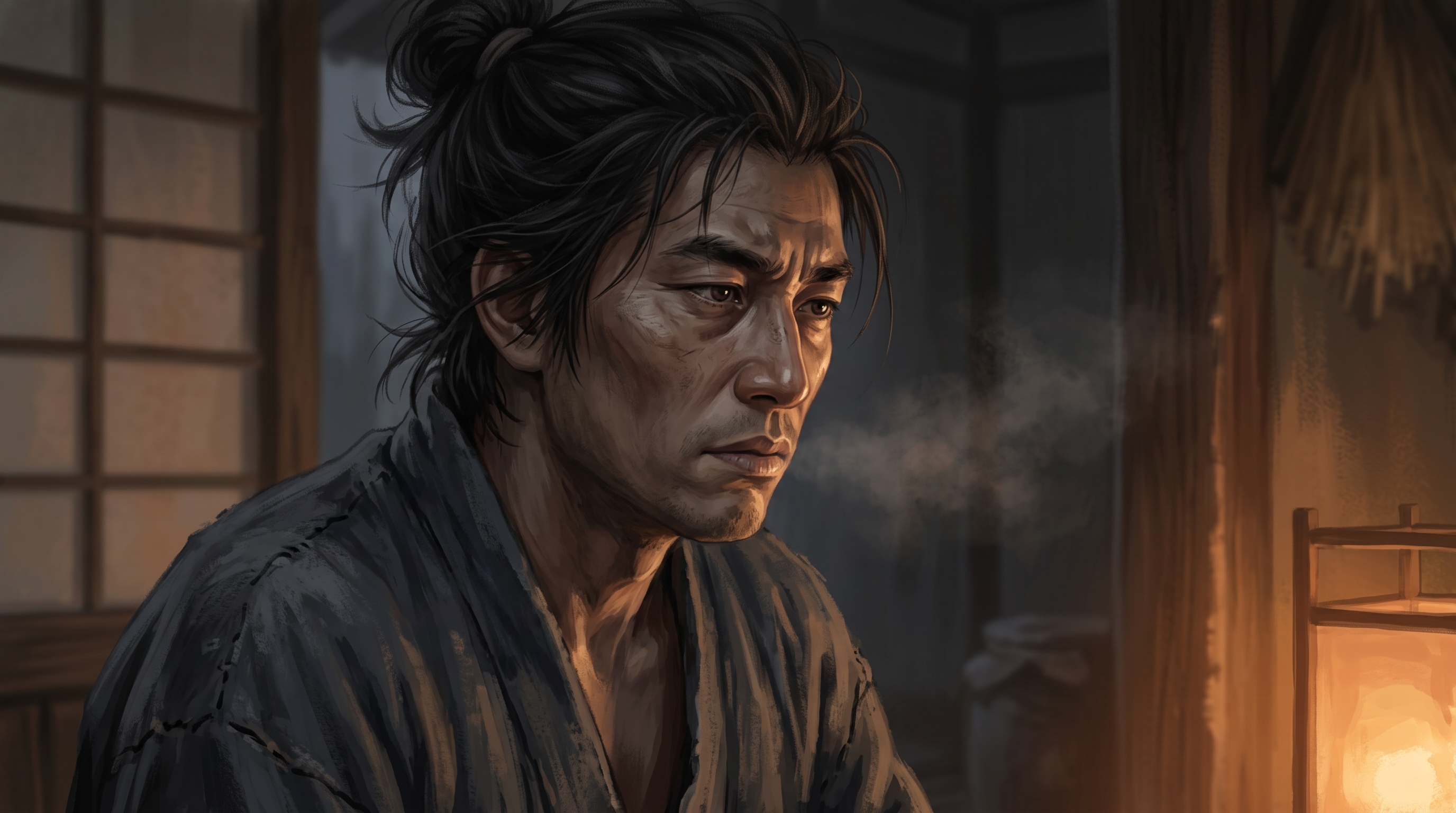 Minokichi’s Recollection.
What distinguishes this account from a simple ghost encounter is its second act. A year later, Minokichi meets a traveling woman named Oyuki on the very same road, and the story — remarkably — lets the reader feel the warmth of courtship before the chill underneath it ever resurfaces. She is parentless, journeying toward Edo for domestic work, charming enough that Minokichi’s mother urges her to delay her trip indefinitely. The marriage that follows is, by every account given, a genuinely happy one.
This is where the tale departs from most Western ghost-story structure, which tends to treat the haunting as the entire plot. Here the haunting is only the prologue. Oyuki bears ten children, nurses Minokichi’s mother through her final illness, and is remembered by the dying woman with real love and gratitude. The village notices only one strange thing about her across those years: unlike every other peasant woman aged by sun and labor, Oyuki never seems to age at all.
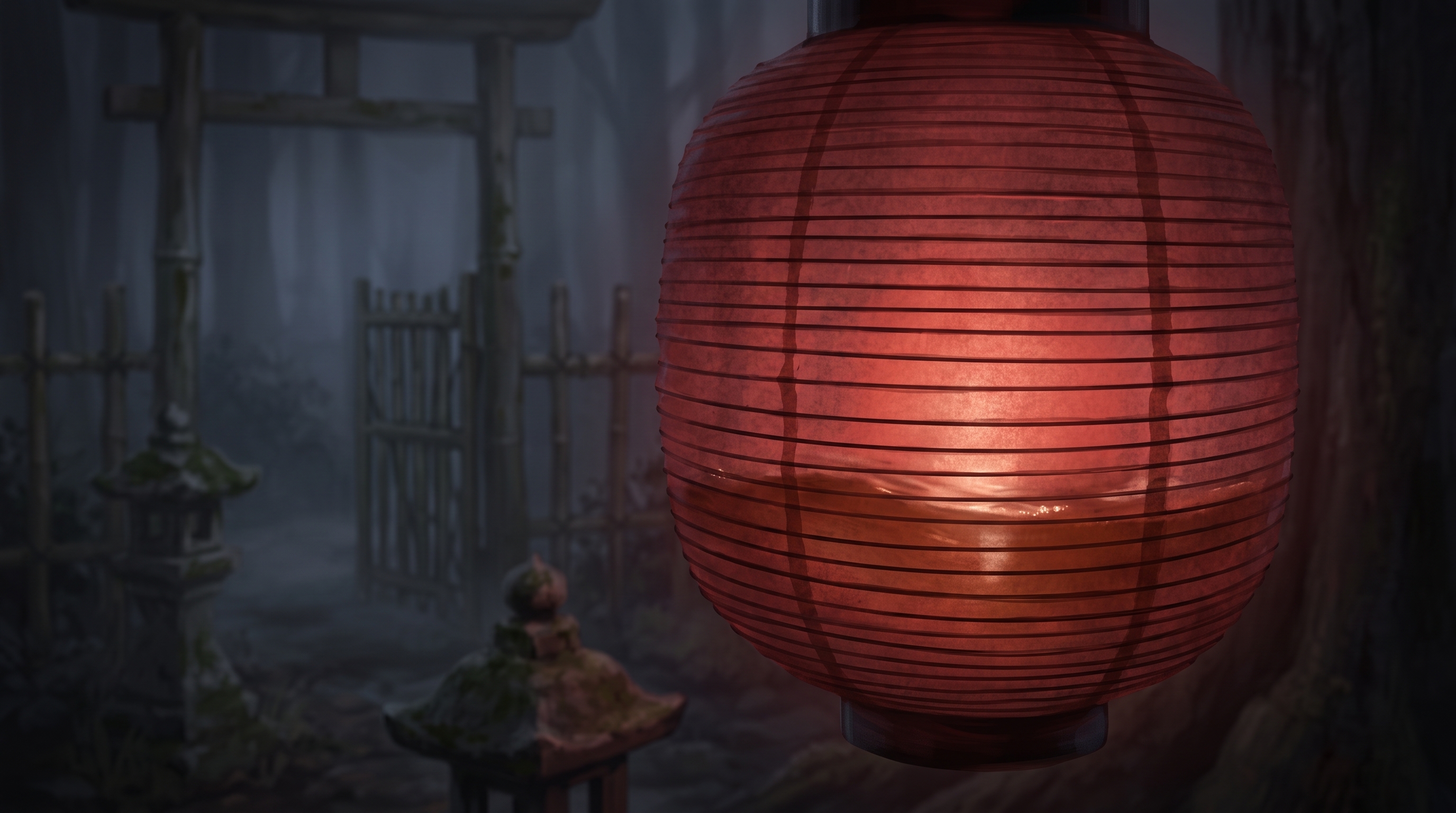
The unmasking, when it comes, is almost gentle in its mechanics — Minokichi simply says she reminds him of someone, half a confession, half idle lantern-lit conversation with his wife. Oyuki’s response folds devotion and threat into the same breath: she will not kill him, for the children’s sake, but she will judge him by how he raises them. Then she thins into mist, rises to the ridge-beam, and passes out through the smoke-vent. The marriage ends exactly where the story began — with a woman made of snow finding the one gap in a wooden room through which she can leave.
Historical Legacy & Archival Footnotes
Yuki-onna predates Hearn’s 1904 transcription by centuries as a figure in regional oral tradition, referenced in scattered Muromachi and Edo-period sources long before any single telling fixed her into print. Hearn’s achievement was not invention but preservation — setting down, in English, a specific telling he encountered at a moment when much of Japan’s orally transmitted kaidan culture was beginning to fade under industrialization and the Meiji-era push toward Western-style modernity. Without that act of transcription, this particular version — the ferryman’s hut, the ten children, the smoke-vent exit — might easily not have survived into the twentieth century at all.
No physical site is tied to the story with any certainty; Hearn’s refusal to name a village was likely deliberate, consistent with the genre’s comfort in geographic vagueness. Musashi Province itself has long since been absorbed into greater Tokyo, its forests and flood-prone rivers mostly channeled, bridged, or built over. What remains is textual rather than physical — Hearn’s own papers and the broader corpus of Japanese folklore scholarship that followed him, much of it now held in university and national archive collections in Japan and the United States.
The tale’s philosophical center is less about fear than about debt. Minokichi survives his first encounter on the condition of silence, and the story’s entire second half is the slow, almost accidental repayment of that debt — not through violence, but through the quiet severing of a life he did not know was borrowed.
Japanese folklore of the Edo period returns again and again to this structure: mercy from the inhuman world is never free, only deferred. The companion video to this article, Yuki Onna: The Snow Woman of the Blizzard, follows that same deferral from the woodcutter’s hut to the lantern-lit room where it finally comes due. This article exists for readers who want to trace that thread back to its oldest surviving page.
What lingers, long after the mist rises through the smoke-vent, is the ordinariness restored at the end of the tale. The children remain. The farmhouse remains. Only the explanation is gone, drawn up through the roof with everything else that could not stay once it had been spoken aloud.
Primary Texts & Scholarly References
- Lafcadio Hearn (1904), Kwaidan: Stories and Studies of Strange Things — the primary English-language source for this telling, including the Musashi Province framing.
- Hayashi Razan and related Edo-period scholarly compilations on regional yōkai traditions, cited widely in later folklore studies for early textual references to snow spirits.
- Toriyama Sekien (1776), Gazu Hyakki Yagyō — the illustrated bestiary that helped visually codify yuki-onna and other yōkai for Edo-period readers.
- Yanagita Kunio (1910), Tōno Monogatari — foundational modern Japanese folklore scholarship, useful comparative context for oral-tradition ghost narratives of this era.
- National Diet Library digital collections, Japan — holding period-relevant Edo-era printed materials referenced in broader kaidan scholarship.
- Koizumi Yakumo (Hearn) archival holdings, housed in part at Japanese university collections documenting his research methods and informants.
Soundtrack & Audio Credits
Music: ‘Black Water’ by Kraosando (https://kraosando.bandcamp.com) — Licensed under CC BY 4.0