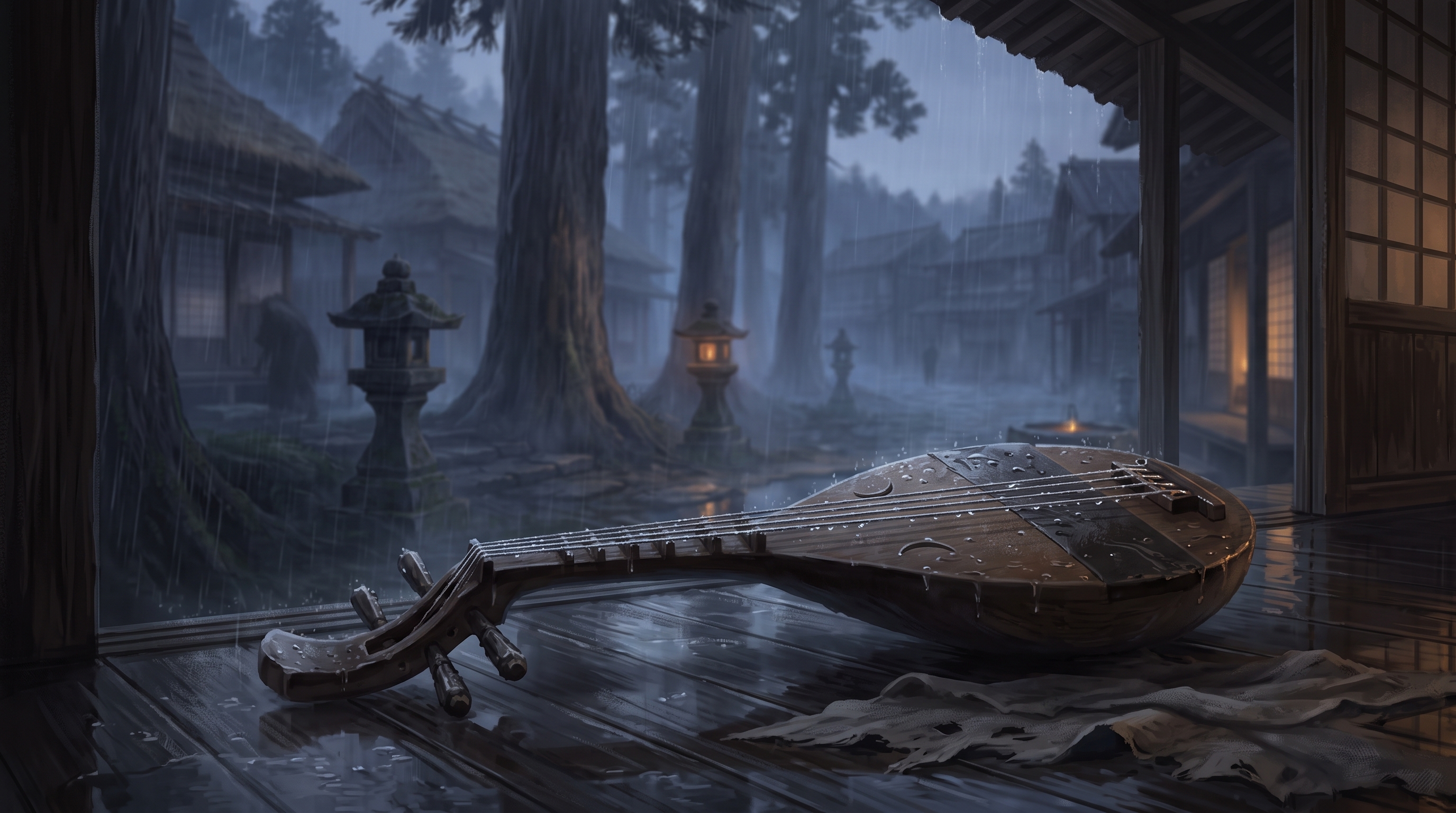

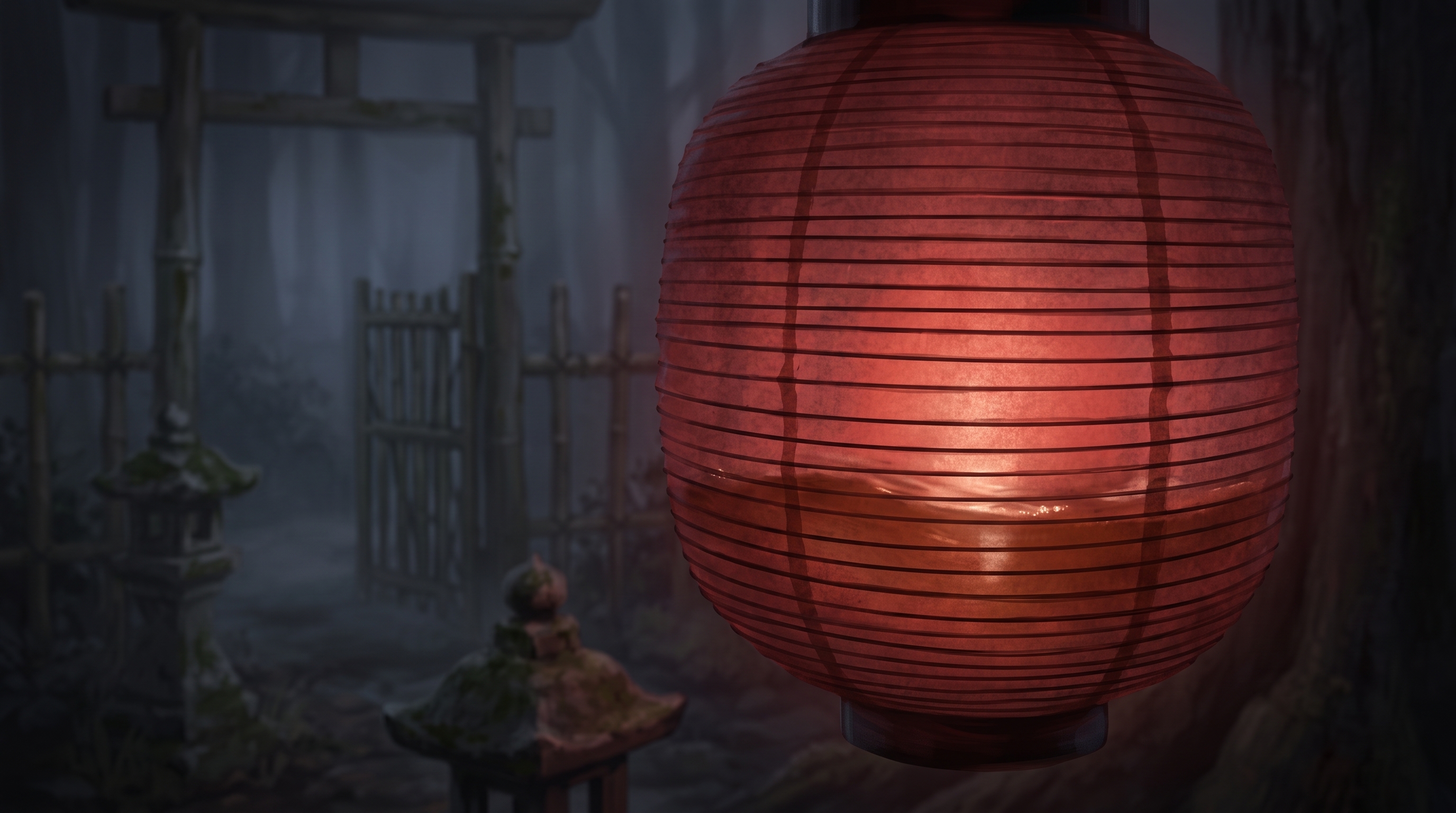
A red lantern does not glow like other lanterns. Most paper lamps cast a soft amber halo, the color of tea left too long in the cup. This one, according to the earliest written account, burned the deep bruised red of peony petals seen through closed eyelids — and it cast no shadow on the ground beneath it. That detail alone, buried in a seventeenth-century manuscript, has kept readers awake for nearly four hundred years.
The Lantern at the Gate
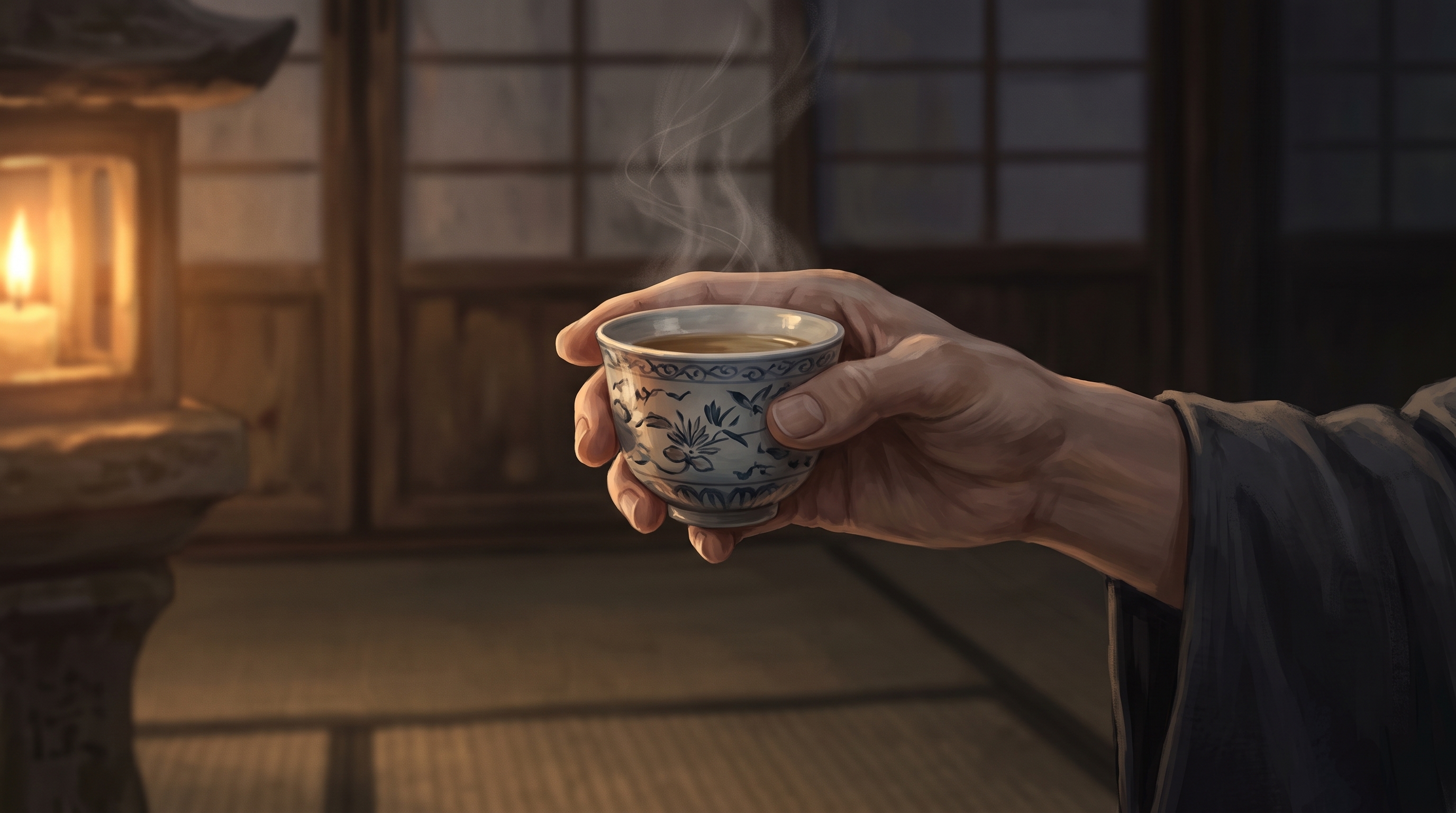 Extended Hand and Teacup.
The tale belongs to the Kanbun years of the Edo period, a time when the city of Edo was expanding rapidly and its back streets still held vacant lots choked with mugwort. In the Hongō district, not far from the Yushima Tenjin shrine, a masterless samurai named Ogiwara Shinnojo lived alone, tutoring merchants’ children by day and sitting on his veranda by night. He had no wife, no family in the city, and only one regular visitor: a retired cooper named Kichibei, who traded pickled vegetables for readings of the Chinese classics.
On the sixteenth night of the eighth month, under a full autumn moon, a maid carrying a peony-shaped lantern tapped its metal pole against Shinnojo’s gate. Behind her stood a woman of extraordinary beauty who gave her name as Otsuyu, daughter of a provincial official recently deceased. She claimed to have followed the sound of Shinnojo’s biwa, though he had not touched the instrument in weeks. He offered her tea. She returned the following night, and the night after that.
Within a fortnight, her visits had become the axis of his existence. Kichibei noticed the change immediately — new robes, incense burning in the tokonoma, a man humming while he swept his garden. But something troubled the old cooper. He never saw the women arrive by the main road. When he peered through gaps in the fence, he heard a woman’s voice but saw Shinnojo speaking, alone, to an empty cushion.
Archival Roots: From Otogi Bōko to Ugetsu Monogatari
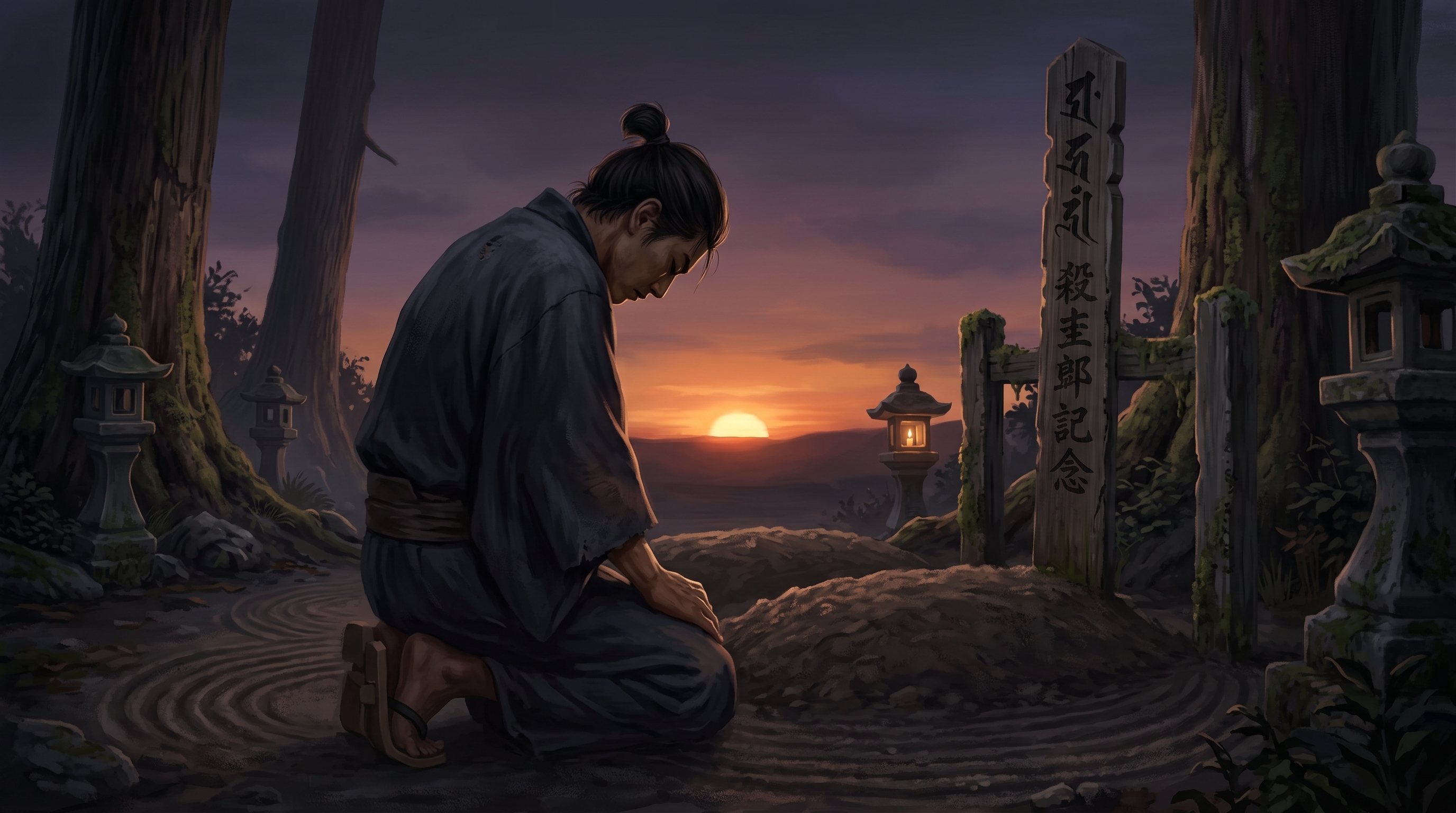 Kneeling at Grave.
This kaidan — known in the Japanese archive as Botan Dōrō, the Peony Lantern — was first set into writing by the scholar Asai Ryōi in his collection Otogi Bōko (1666), a text that adapted Chinese ghost stories into Japanese settings and gave the tale its enduring shape. Decades later, Ueda Akinari refined the atmosphere and moral weight of the story in Ugetsu Monogatari, the collection now considered the summit of Edo-period ghost literature. The version explored here follows the earliest printed account, cross-checked against oral variants preserved in the folklore archives associated with Yanagita Kunio.
Why the Lantern Mattered
Lanterns in Edo-period ghost literature were never decorative. A lantern that produced no shadow, or burned without consuming oil, signaled to any literate reader that its bearer did not belong to the world of the living. Asai Ryōi’s audience would have recognized the peony motif instantly — flowers associated with beauty, decay, and the fleeting nature of both. The lantern was not a prop. It was the story’s first and clearest warning.
The House Near Yushima Shrine
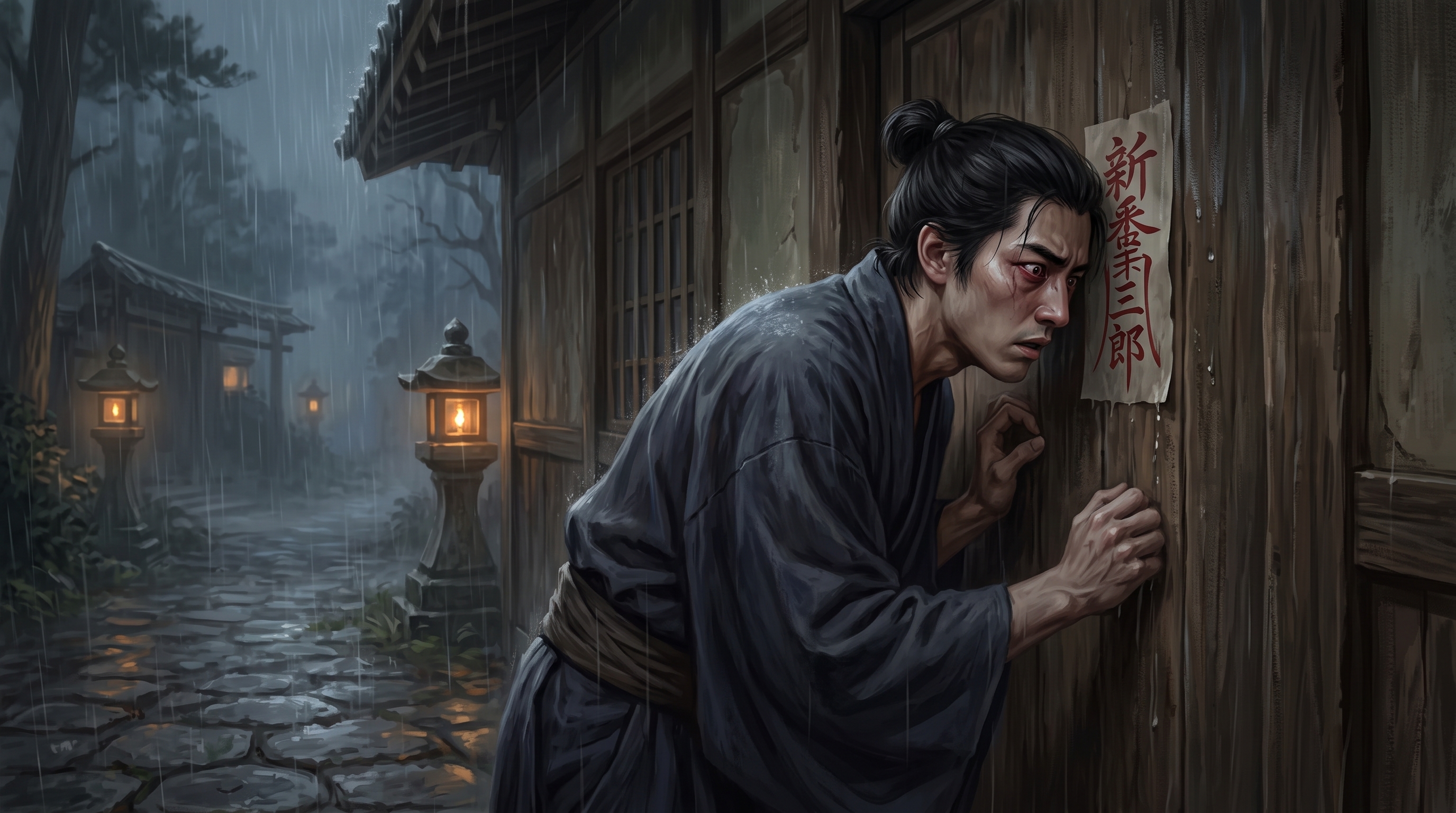 Shinzaburo’s Cracking Resolve.
Kichibei, who had lived in the ward for forty years, knew every family within a league of the shrine. He had never heard of an official’s daughter by the name Otsuyu. Walking to the address Shinnojo had described, he found only a vacant lot overgrown with mugwort, and at its edge a neglected cemetery plot. One grave alone was freshly tended: a double mound with a wooden sotoba still legible, bearing the posthumous names of a young woman and her servant.
The death date carved into the marker was the sixteenth day of the eighth month of the previous year — precisely one year before the lantern first appeared at Shinnojo’s gate. When Kichibei told him what he had found, Shinnojo did not argue. He asked to be taken to the grave, and knelt before it until sunset. That night he lit every lamp in his house and sat with a short sword across his lap, listening for the tapping he knew would come.
It came. Otsuyu’s voice, soft and wounded, called his name from beyond the fence, asking why the gate was locked. He pressed his hands over his ears and recited the Heart Sutra until the tapping stopped. This restraint — grief warring with fear — is the emotional center the Kanbun-era text lingers on longest, more than any description of the ghost herself.
The Talisman and the Breaking of the Seal
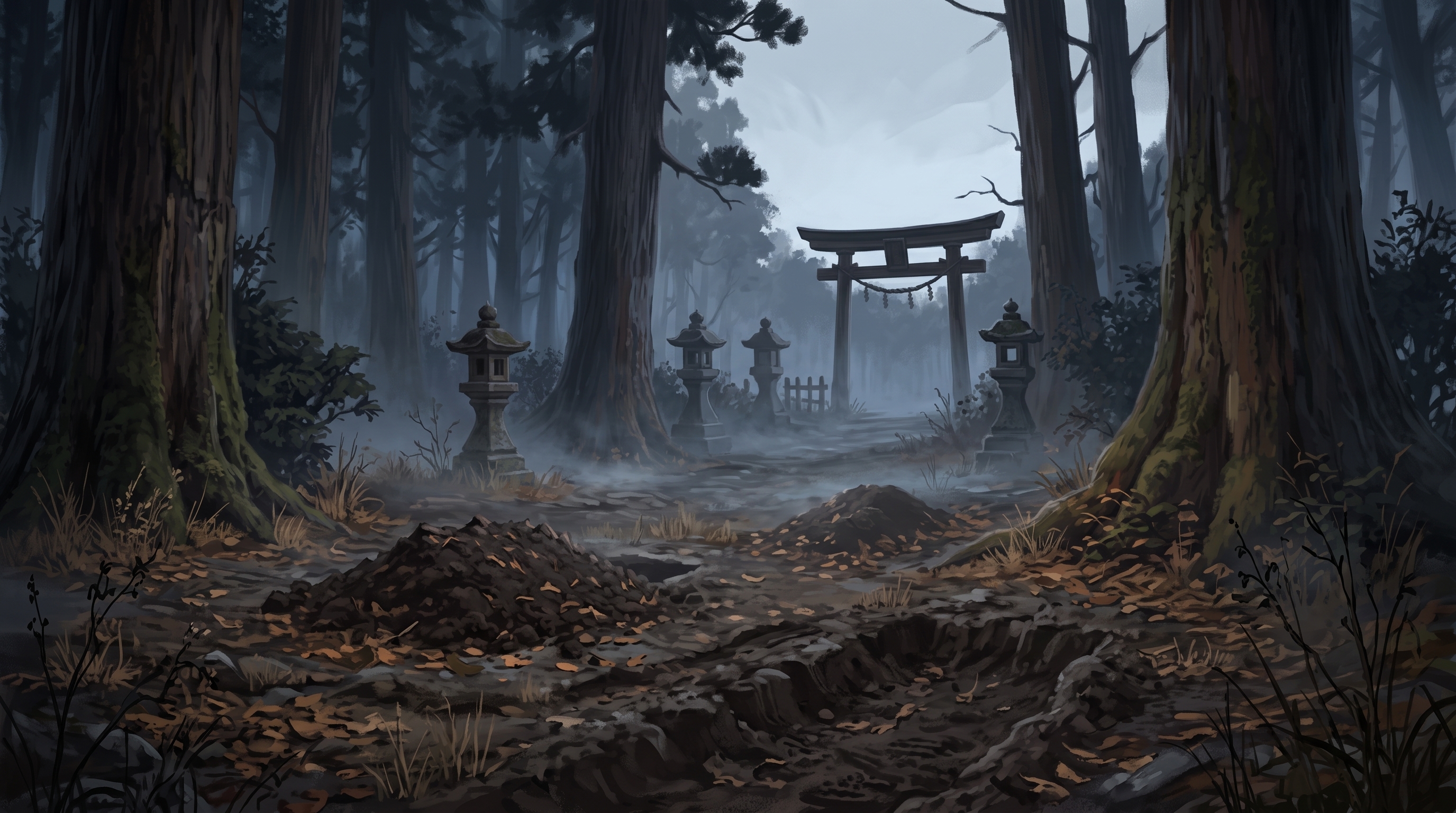 Desecrated Grave Site.
The next morning, Shinnojo traveled to the temple of Shinju-an in Yanaka, where the priest Jikaku, trained in Shingon esoteric practice, agreed to perform a segaki — a feeding ritual for hungry ghosts — rather than a simple exorcism. This distinction matters historically: Edo-period Buddhist practice generally treated the restless dead with ritual compassion, not confrontation. Jikaku inscribed a fuda, a paper talisman bearing the seed syllable of the bodhisattva Jizō, protector of the dead, in vermilion ink on mulberry paper.
He affixed the talismans to every threshold of the house — gate, door, veranda, and the small kitchen window — while chanting the Daihishin Darani. His instruction was direct: do not remove them, do not answer any voice from outside, and remain indoors after sunset for forty-nine days, the traditional Buddhist mourning period believed necessary for a soul’s passage. For seven nights, the wards held.
On the eighth night, a storm rolled in from the bay. Otsuyu’s voice returned, weeping, insisting she was alive and merely ill. Shinnojo pressed his forehead to the door and did not open it. But on the twentieth night, the maid Oyone appeared at the unguarded kitchen window, pressing her palm against the paper screen until the rain-soaked vermilion ink bled into an illegible smear. The seal, quite literally, dissolved under weather — a detail that later folklorists have read as a meditation on the fragility of ritual protection against grief that refuses to be sealed away.
What Was Found, What Remained
Three days later, Kichibei forced open the gate. The talismans on the front door and main gate were intact; only the kitchen seal was gone. Inside, Shinnojo lay on the tatami, his arms around a skeleton browned with grave soil, its skull resting against his chest. The magistrate’s winter 1666 record lists the cause of death as “heart failure due to fright,” though Kichibei’s testimony insisted the dead man’s lips were curved in a smile.
The double grave was exhumed and reconsecrated, and a small stone Jizō was placed there to pacify the spirits — consistent with standard Edo-period practice for graves associated with unexplained deaths. Local children were forbidden from playing near the lot after dark for a generation. Fifteen years later, in 1681, a merchant named Sōshichi moved into a house built on the same land and fled within the month after hearing a woman humming in the garden and finding a single fresh peony petal on the gate’s stone step.
Historical Legacy & Archival Footnotes
The Peony Lantern tale occupies a foundational place in Japanese ghost literature precisely because of its layered transmission: first Asai Ryōi’s Otogi Bōko, then Ueda Akinari’s more psychologically refined Ugetsu Monogatari, and later a celebrated rakugo adaptation by the Meiji-era storyteller Sanyūtei Enchō, whose spoken performance popularized the tale for a wider urban audience and cemented the phrase Botan Dōrō in the popular imagination. Each retelling shifted emphasis — Ryōi toward moral warning, Akinari toward the tragedy of longing, Enchō toward suspense and comic relief in equal measure — while preserving the lantern, the talisman, and the broken seal as immovable structural elements.
The physical site, once marked on old maps with the single character rei (“spirit”), now lies beneath a modern apartment building in Bunkyō ward. No storehouse, no grave marker, no lantern survives in any confirmed archive; the Shinju-an temple is said to have kept a fragment of the talisman for over a century, but its present location is unrecorded. A marginal note in the Otogi Bōko manuscript — unsigned, on water-damaged paper — claims the lantern was “found lit the following morning, though no oil remained.” Whether scribal embellishment or something stranger, the archive offers no verdict.
What endures is the story’s central proposition, one that recurs throughout Edo-period kaidan: that grief and desire, if strong enough, can wear the shape of the living long enough to be mistaken for them. The talisman fails not because the ritual was wrong, but because water — ordinary, natural, indifferent water — undoes ink faster than devotion can renew it. It is a remarkably unsentimental moral for a ghost story, and perhaps why it has outlasted three centuries of retelling.
Primary Texts & Scholarly References
- Asai Ryōi (1666), Otogi Bōko — the earliest printed source for the peony lantern narrative.
- Ueda Akinari (1776), Ugetsu Monogatari — the literary refinement most responsible for the tale’s canonical status.
- Sanyūtei Enchō (Meiji era), Botan Dōrō rakugo performance transcripts — popularized the story for oral audiences.
- Yanagita Kunio, folklore archive materials on Edo-period ward legends and grave customs.
- National Diet Library digital collections, Edo-period magistrate records (Kanbun era civil registers).
Soundtrack & Audio Credits
Music: ‘Die Statue OST’ by Kraosando (https://kraosando.bandcamp.com) — Licensed under CC BY 4.0